Best eSIM with Hotspot for Australians traveling to Japan: Why I chose Awinst Connect
TLDR:
If you're from Australia and planning a trip to Japan where you'll be using a hotspot regularly, Awinst Connect is my top recommendation.
After comparing several unlimited eSIM providers for Japan, I chose Awinst Connect for one simple reason: this service offers a hotspot with no daily tethering limit, making it a much more convenient option for families, digital nomads, and anyone traveling with multiple devices.
In short, you get:
- ✅ Unlimited internet on the main device
- ✅ Hotspot without daily tethering limit
- ✅ Access to the premium KDDI au network in Japan
- ✅ Simple activation before departure
- ✅ Practical solution for laptops, tablets and family trips
For many travelers, the phrase “unlimited internet” sounds convincing enough. But once you start thinking about laptops, kids’ tablets, hotel Wi-Fi, Google Maps, translation apps, Shinkansen tickets, and video calls, a hotspot becomes just as important as mobile internet itself.
This is exactly what I realized while planning my own trip to Japan from Australia.
Why I Started Looking for eSIM with Hotspot
When I first started planning our trip to Japan, it seemed like choosing an eSIM would be very easy.
We flew from Australia to Japan for almost three weeks. Part of the trip was going to be active: Tokyo, train stations, walking, sightseeing, food markets, day trips, and hotel transfers. The other part was planned to be more relaxed: relaxing in hotels, leisurely evenings, looking at photos, and some free time after long days in the city.
At first, I was only interested in one thing: unlimited internet.
Like many travelers, I assumed that if I bought an unlimited eSIM for Japan, everything else would be taken care of. I could use Google Maps, call a taxi if needed, translate menus, check train schedules, and stay in touch with people back home in Australia.
But then I started thinking about how we actually travel.
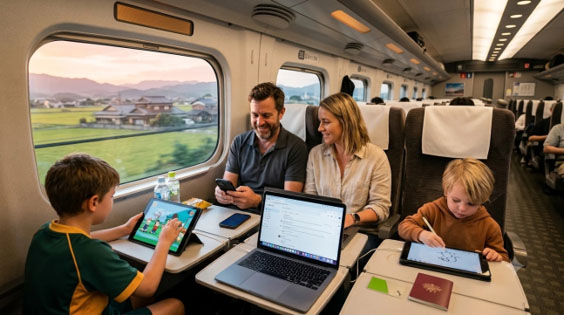
I knew I would have to work sometimes while I was traveling. Not full-time, but enough to open my laptop, answer emails, download files, and maybe join a call or two. The kids brought their tablets for the flight and for their hotel time. My wife also needed internet for messaging, maps, reservations, and sharing photos.
That's when I realized something important: a hotspot isn't just an optional feature. It's going to be essential.
A regular plan with mobile internet on my phone would be enough if I were traveling alone and using only my smartphone. But for a family trip, especially when there are multiple devices, a hotspot becomes the difference between "I have internet" and "everyone can connect when they need it."
And this is where many travel eSIM plans start to differ greatly from each other.
Why Hotspot in Japan is More Important Than Most Travelers Think
Japan is an incredibly convenient country to travel to, once you understand how things work. But it's also a country where mobile internet is becoming a part of almost every decision you make while traveling.
You use it for navigation. For translation. For train schedules. For restaurant reservations, hotel confirmations, QR codes, tickets, maps, weather forecasts, and notifications.
During a typical day in Japan, mobile internet may be needed for:
- Google Maps while walking around Tokyo or Osaka
- Google Translate for reading signs, menus, or product labels
- SmartEX or railway apps for booking Shinkansen tickets
- Restaurant reservations or electronic queuing systems
- Hotel check-in information
- Messages to family or fellow travelers
- Checking platform numbers and transfers
- Payment for services or access to QR tickets
- Upload photos and videos
- Checking the opening hours of locations before visiting
If you're traveling alone, a phone might be enough. But when two, three, or four people are traveling together, things change quickly.
Someone wants to check Google Maps. Someone else is texting their friends. The kids want to watch something on their tablets while you wait at the train station. You need to open your laptop at the hotel because the Wi-Fi is too slow. And suddenly your phone is not just a phone anymore. It becomes the main source of internet for the whole group.
This is especially true in Japan, where hotel Wi-Fi can be unpredictable. Some hotels have great internet. Others are slow, inconsistent, or overloaded in the evenings when everyone returns to their rooms. Traditional ryokans and small hotels can also have weaker Wi-Fi than you might expect.
Even on trains, a hotspot can be very useful. The Shinkansen is comfortable and convenient, but if you want to work from a laptop or use a tablet during the trip, your own connection is much more reliable than public Wi-Fi.
That's why a hotspot in Japan is more important than many travelers realize. You don't necessarily need it all the time, but when you need it, you really need it.
Not All Unlimited Plans Are Unlimited Equally
This was one of the main lessons I learned when choosing an eSIM for Japan.
At first, I saw the word “unlimited” and assumed that all unlimited eSIM plans were about the same. But when I read the terms more carefully, I realized that “unlimited internet” doesn’t always mean “unlimited hotspot.”
There is a big difference between unlimited mobile internet on your phone and unlimited hotspot or tethering for other devices.
The vast majority of plans that offer unlimited internet for use on your phone limit the amount of data that can be distributed via hotspot in one way or another. Some allow hotspot only up to a certain daily volume, others reduce the speed after a certain threshold, and still others have fair usage rules that are not always obvious at first glance. So, when you choose an unlimited eSIM with a hotspot, you should understand that there will be no completely unlimited hotspot. So choosing a tariff is always a matter of compromise.
This doesn't mean that all plans are bad. For many travelers, they may be perfectly fine. If you only need a hotspot occasionally - to check your email or share your internet for a few minutes - a limited plan may be enough.
But if you travel with family, work remotely, use a laptop, or share your internet connection across multiple devices, such limits can quickly become a problem.
Another difficulty is that hotspot usage is not always predictable. One day you may barely use it. Another day - especially on a rainy day or while traveling - your data usage may skyrocket.
Examples of Data Usage via Hotspot
Before choosing an eSIM, I tried to roughly calculate how much data we could actually use via hotspot.
This was really helpful because it made the decision much clearer. It's easy to think, "I probably won't use the internet that much." But when you add laptops, tablets, video calls, and streaming, hotspot usage quickly increases.
Here are some approximate examples:
|
Activity
|
Approximate hotspot usage
|
|
1 hour Zoom call
|
1–1.5 GB
|
|
Netflix HD, 1 hour
|
About 3 GB
|
|
YouTube 1080p, 1 hour
|
2–3 GB
|
|
Google Maps during the day
|
Less than 300 MB
|
|
Children watching cartoons on 2 tablets
|
4–6 GB
|
|
Working from a laptop for 8 hours
|
2–5 GB
|
|
Upload photos and short videos
|
1–4 GB
|
|
Video call with family in Australia
|
500 MB–1.5 GB
|
|
Normal browsing and messaging
|
200 MB–1 GB
|
Of course, these are just estimates. Actual usage depends on video quality, app settings, background syncing, and the number of connected devices.
But this table helped me understand an important thing: hotspot usage is uneven.
My family could use less than 1GB of data per day via hotspot. If we were out and about in Kyoto or Tokyo all day, we would need mobile data mostly for maps, train schedules, and messaging.
But on a rainy day, when everyone was stuck in the room for a few hours, usage could easily exceed 5–10 GB. Two tablets with cartoons, a laptop with file syncing, a few video calls, and photo uploads all add up quickly.
That's why the daily hotspot limit seemed risky to me.
It wasn't just about the total number of gigabytes. It was about freedom. I wanted a plan that would work on days with minimal usage and days with heavy usage - without having to constantly check to see if we were approaching our daily tethering limit.
This was one of the main reasons why Awinst Connect stood out from the other options. Despite the overall hotspot limit within the selected three-week plan, this provider did not limit daily hotspot usage, which was extremely convenient in my situation.
Who Really Needs a Hotspot When Traveling in Japan?
Not every traveler needs a hotspot. If you're traveling to Japan alone, using only your phone, and staying in hotels with stable Wi-Fi, then you may not need tethering.
But for many travelers, a hotspot is extremely useful.
- Family travelers
- Digital nomads
- Business travelers
- Content creators
- Couples
- Students
- Photographers
- Backpackers with laptops
Situations When a Hotspot Came to the Rescue
The reason I pay so much attention to hotspots is not theoretical. It's very practical.
There are many situations in travel where a hotspot can make the day much easier, for example:
- Working from a hotel with slow Wi-Fi
- Internet for kids on a rainy day
- Uploading photos before the next train
- Buying Shinkansen tickets at the last minute
- Video calls from a cafe
- Navigation when everyone is using different devices
Why I Ultimately Chose Awinst Connect
After comparing different eSIMs for Japan, I ultimately narrowed my choice down to two main criteria:
- Unlimited internet on the main device
- No daily hotspot limit
The last point was the most important.
Many eSIM plans looked appealing at first glance. Some were well priced. Some had strong marketing. Some advertised unlimited data. But when I checked the hotspot terms, not all of them matched how I planned to travel.
Awinst Connect stood out because it offered exactly the combination I needed: unlimited Internet on the main device and a hotspot with no daily tethering limit.
For a solo traveler who only uses a phone, this might not be that important. But for my situation - traveling from Australia to Japan with family, multiple devices, and occasional work - it made a big difference.
Another reason I liked Awinst Connect was the network. It works over the premium KDDI au network in Japan, one of the country's major mobile networks. When traveling, network quality matters. You don't want to constantly wonder if your connection will work at the airport, in the city, on the train, or near your hotel.
I also liked how easy it was to set up. With an eSIM, you don't have to pick up a physical SIM card, wait in line at the airport, or swap out small cards after a long flight. You can set up your eSIM before you leave and be ready to go when you arrive.
This is especially handy for Australians flying to Japan. After a long international flight, the last thing you want to do is stand around and fiddle with your internet. You want to land, turn on your connection, open your maps and move on.
This simplicity was also an important advantage.
But the hotspot still remained the main factor.
I chose Awinst Connect not because of one flashy feature. I chose it because it solved the exact problem I was concerned about: the ability to distribute reliable internet to multiple devices without constantly checking the daily hotspot limit.
|